Thursday, 27 June 2019

The Swordmaking Legacy of Longquan

The Quest of A King

Legend has it that an ancient ruler of China, King Chu, once called the greatest swordsmith of the land to make him a few masterwork weapons.  That man’s name was Master Ou Yezi.   Ou heeded the King’s command and traveled far and wide, looking for a place in which he could make such weapons.  He finally found a suitable place – one with plentiful iron for smithing, special water for quenching, and suitable stones for grinding.  The name of the place was Lonqquan.

Master Ou Yezi

There, Master Ou spent three years of labor, painstakingly crafting the blades the King wished for.  In the end, he created three swords: Longyan, Tai’e, and Gongbu.  The first sword, Longyuan, means “Dragon Abyss”, and was named such because its shape reminded the viewer of someone standing at the top of a tall cliff and looking down.  The second sword, Tai’e, means “Great Mountains”, and was named so because its soul existed in the mountains where the sword was forged before being contained in the sword.  The last, Gonbu, meant “Exquisite Cloth”, due to it feeling as smooth as silk when touched.  The King was pleased with these swords, and Master Ou’s name has been revered among Chinese swordsmiths since that day.

LongQuan

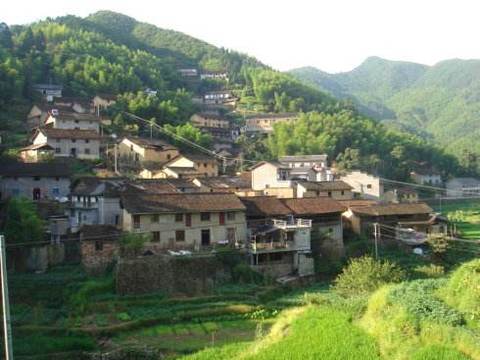
Nestled by the tallest mountain in the province, the town of Lonquan still holds much of its ancient beauty.  Surrounded by forest and a nearby a river, this quiet town contains the top swordsmiths of China.  Supposedly the water in the river has minerals that react with the sword during quenching to enhances its sharpness and resilience.

Longquan

Getting there is a journey – there are no airports or major transport hubs.  Once there, one can visit the many swordsmithies in the area.  Swordsmaking is a tradition handed down from master to apprentice that has been passed on for centuries.  Unfortunately, this tradition is in danger as fewer apprentices choose to make swordsmithing their career due to the hard work and low pay, instead choosing to look elsewhere for job opportunities.  The quality of Longquan swords is unmatched, with local smordsmiths having made swords for foreign leaders, movies, and for wealthy clients who can afford to pay for the months of work it can take to make just one high-quality sword.  The swordsmithing of Lonqquan has been recognized as an Untangible Cultural Heritage of China.

Fun Facts

The ancient name of Longquan is actually Longyuan (the same name as the first legendary sword made by Master Ou Yezi).  Due to a later leader named Yuan, the name was changed out of respect and to avoid naming conflicts.

The art of swordsmithing was originally imported into Japan from China.  Now history has come full circle, with Chinese smiths having imported the knowledge from Japan for making Katana and other Samurai Swords.

Our Swords

Many of our swords come from Lonquan, guaranteeing their high quality.  It gives us pride to work with smiths from such a distinguished heritage.

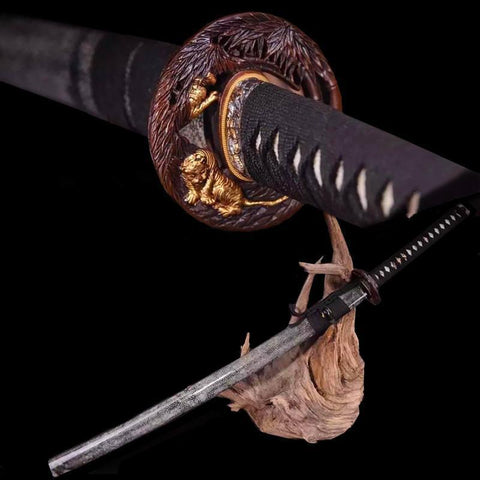
Elite Sword

See Our Swords


source https://www.bladespro.co.uk/blogs/news/swordmaking-legacy-longquan

Roman Empire vs the Mongol Empire (Part 1)

Both the Roman and Mongol Empires were juggernauts of their times.  With vast swaths of territory and tens of millions of conquered peoples living in their realms, these Empires would be unrivaled until the late British Empire.

In Part 1 of this 2-part series, we explore, briefly, the rise and fall of these two great powers. In Part 2, we will compare and analyze them on several criteria.

Roman Empire

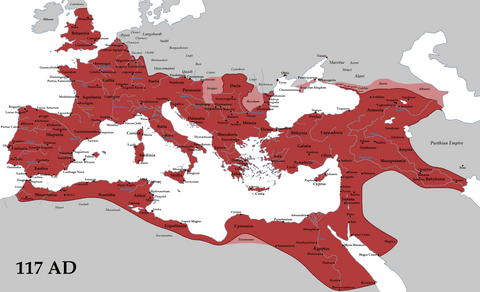
Roman Empire's Greatest Expanse

Tracing its roots to the 6th century BC with the founding of the Republic, the Roman Empire began humbly.  Consisting of nothing more than the city of Rome and a few outlying towns, it gradually expanded until it began to reach beyond the Italian peninsula around the 3rd century BC.  In the 2nd century BC, the Republic of Rome began to suffer internal discord while simultaneously beginning to rapidly expand its borders. This led to the need for a strong central command and, eventually, the first dictator Julius Caesar.

Julius Caesar was assassinated in 44 BC. His adopted son Octavius and Marc Antony divided the Empire between them, then eventually attacked each other.  Octavius won and was given the title of princeps, meaning “first citizen”, and the name Augustus in 27BC.   Augustus was well-liked because he ended a century of turmoil and strife, and his rule began the start of what was called the Pax Romana, a 2-century long peace where the Empire flourished. 

As with all good things, this was not to last, and the Empire eventually fell into turmoil around 180 AD.   After a century, Aurelian managed to stabilize the empire and Diocletian fully restored it.  Rejecting the title of princeps, he became the first ruler to take the actual title of Emperor.  Apparently happy with his deeds, he divided the empire into separate parts, each ruled by its own ruler, then abdicated the throne.  This didn’t work, and it was up to Constantinian the Great to fix the mess. Constantinian established a second capital in the East called, appropriately enough, Constantinople.  After a later ruler Theodosius I died, the Western side of the Empire began to disintegrate due to immigration and invasion problems from the Germanic peoples, and was basically gone after only a short century.  The East side was much more successful and lasted for another thousand years before finally falling.

Mongol Empire

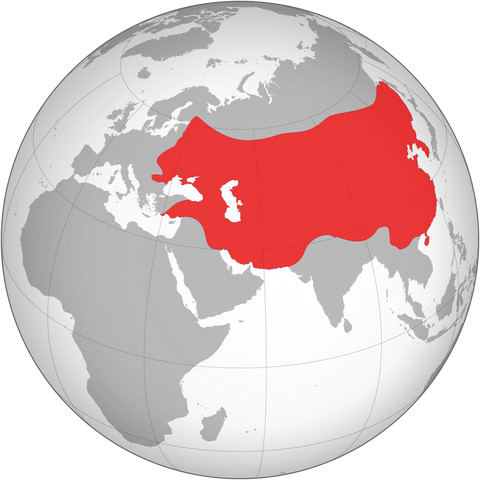
Mongol Empire Greatest Extent

Compared to the slow build up of the Roman Empire, the Mongol Empire hit like a lightning strike.  The Mongols were disorganized nomadic tribes that usually couldn’t get along and were encouraged in their internal strife by their neighbors in order to keep them under control.  That all changed, however, with the rise of Genghis Khan, who united the tribes in 1206 AD and set out to build himself an Empire.

He moved quickly, taking over what is now Northern China, eastern Persia, and Ukraine.   By his death, the Mongol Empire was twice the size of the Roman Empire at its peak.  He died in 1227, a mere 21 years after his conquest began.  Due to questions over the paternity of his oldest son, he was forced to name his third son Ogedei as his heir.  Ogedei expanded the empire, incorporating southern China and southern Persia. He reached as far as Korea, though he did not succeed in annexing the peninsula, instead forced to rule it politically through marriage.  He also invaded parts of India, though he eventually had to withdraw.  After one of his sons died, the Empire lost part of southern China, but managed to expand northward into what is now Russia, taking the capitol Kiev.  The Empire expanded into Europe, reaching as far as modern Poland before being halted by news of Ogedei’s death.

Ogedei’s son Guyuk eventually took power, but the Empire was weakened by a period of division when Ogedei’s widow unsuccessfully tried to rule the Empire and one of the most powerful Mongol military leaders refused to recognize her.  Guyuk tried to reduce corruption, expand, and maintain the empire.  He was sickly and ill, and died during travel, so a man named Mongke became Emperor, marking a switch in power from Ogedei’s line to another son of Genghi’s line Tolui.  Mongke sought to expand the Empire, but made some mistakes, allowing significant opposition and a halt to the Mongol’s advances for the first time.

War and strife followed, and eventually a Mongol leader rose to power who succeeded in fully conquering all of China, founding the Yuan dynasty.  While his and his descendants’ rule was weaker than those that had gone before, with much of the Mongol Empire being ruled independently by others who did little more than acknowledge the Yuan’s rule and send tribute.  The Empire eventually began to collapse due to religious intolerance among its disparate parts, the Black Death, and corruption. Thus marked the end of the Pax Mogolica: a period of piece lasting around a 100 years with great economic growth and relative peace and safety from the Pacific Ocean to the Mediterranean.

See Our Swords


source https://www.bladespro.co.uk/blogs/news/roman-empire-vs-the-mongol-empire-part-1

Wednesday, 26 June 2019

The Notorious Opera Duelist of Paris - Julie d'Aubigny

Few women have achieved the notoriety throughout their entire lifetime that Julie d'Aubigny acquired in just two short decades.  Famous for her insatiable sexual appetite and martial prowess, two things that regularly got her into trouble, she would have perished early in life if not for her father’s close contacts with the king.

Young Julie

Teenage Duelist

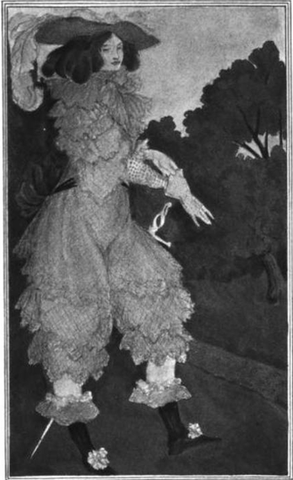
Julie d'Aubigny was effectively raised as a man, the son of the secretary to Horse Master Louis de Lorraine-Guisea.  Her father’s job was to train the court pages, and she was raised under his tutelage as well.  From him, she learned dueling, horseback riding, dancing, and reading, among other traditionally “manly” skills.  Her choice of men’s clothes reflected her upbringing.

Her dress didn’t stop her from attracting the eye of the Count d'Armagnac, who took her as his mistress when she was only 14 years old.  For some reason, the Count decided to marry her off to Sieur de Maupin, whom she stayed married to for life, though ne’er faithful.  When her husband moved to the South of France, she stayed in Paris (possibly at the Count’s request), and began to engage in antics that would make the ears of the noble class ring.

First, the very same year, she hooked up with an assistant fencing master who had similar proclivities as she.  After he killed a man in a duel (dueling was illegal in Paris by the King’s edict), they had to flee.  Making a living by singing duets and demonstrating their fencing skills, they traveled through the countryside.  Because Julie’s fencing skills were so incredibly, she was occasionally accused of being a man pretending to be a woman.  According to a story, she got so tired of this that, one day, she tore open her blouse in order to prove that she was indeed a woman.

For people whose craving for excitement knows no bounds, loyalty doesn’t factor in very high, so it wasn’t long before she tired of her traveling lover and decided to try her luck with a woman.  Her new choice’s parents were less-than-pleased with her decision and sent the woman away to a nunnery.  Undeterred, Julie managed to enter the same convent by pretending to be an initiate, then arranged their escape by placing the corpse of a recently-deceased nun in her girlfriend’s room, setting it on fire, then fleeing during the chaos.

This affair lasted only 3 months, but it was not without consequences.  For her deed, Julie was charged with arson, kidnapping, body snatching, and failing to show up to court. Possibly because of the inability to comprehend bisexuality at the time (“Why would a woman run off with another woman? Only a man would do so.”), she was charged as a man, so the sentence was severe – death by fire.

Julie d'Aubigny

Opera Singer

During her adventures trouping around the county, she had managed to attract the attention of some opera talent scouts who pushed for her to join the Paris Opera.  She headed toward Paris but first had to first deal with the charges hanging over her head.  Luckily for her, her father was able to contact the King and get the charges cleared.  She joined the Opera, playing some very strong female parts, and her voice attracted renown.

Of course, being Julie d'Aubigny, she couldn’t quite blend in with the other performers.  At one ball, she publically kissed a woman, which attracted the attention of three men who dueled her.  She won every duel.  She had to flee Paris due to the anti-dueling laws, until she was once again able to obtain a royal pardon, with the King rationalizing that the laws only applied to men. Even during all this, she somehow found the time to seduce the then-governor of the Netherlands.

Returning to the Opera, she challenged a man known for bothering female singers, and when he tried to refuse, she mugged him.  Not wanting to admit to the embarrassment, he made up a story that he had been attacked, which she quickly refuted by producing a pocket watch she had taken from him.

True Love And Heartbreak

Julie was fated to die young.  She fell for a mistress Marquise de Florensac, whose death after two years proved too much for the still-young Julie, who had finally found love at long last.  Joining a convent for real this time, she lived there another few years until her death at the young age of 33.

See our Dueling Swords


source https://www.bladespro.co.uk/blogs/news/the-notorious-bisexual-opera-duelist-of-paris-julie-daubigny

Wednesday, 12 June 2019

3 Legendary European Swordsmen

From the mid-16th century to the 18th century, there lived in Europe three swordsmen whose skills were legendary.  What makes these men remarkable is that their skill at dueling was the only commonality these men shared.  They were each incredibly different in their temperaments, skills, and chosen paths in life.


Achille Marozzo—The Renaissance Fencing Master

The first legend was Achille Marozzo, an Italian fencing master who followed the fencing tradition of the Bolognese school.  He is remembered today for his treatise Opera Nova dell’Arte delle Armi, which mostly covers how to use various weapons or guards in tandem with a sword.  Today, this work serves as a window into 16th century fencing styles and theory and is studied by many historical fencing groups.

There is not much known about his personal life.  What little we know about him comes mainly from his esteemed work.  From lines such as “You must never attack without defending, nor defend without attacking” we can discern that he was a fairly calculating individual.  We know he studied under Guido Antonio Di Luca, who trained a great many warriors.  Marozzo became a teacher in his own right, as one contemporary noted that he “had trained an immense number of valiant disciplines.”

Donald McBane—The Scottish Duelist Extraordinaire

Donald McBane was really a character.   He was a womanizer and had the ability to get into trouble almost no matter what he did.  Dueling for him was a double-edged sword – it got him into trouble as often as it got him out of it.  If it weren’t for the fact that he was often well-liked by those above him, he would have been unlikely to have achieved as much as he did.

Donald first learned swordsmanship when the elder soldier assigned to him regularly “dipped” into his wages.  Donald paid for private instruction from a sergeant, then, as was the custom of the time, Donald challenged the elder soldier to a duel, which he then promptly lost.  After taking more lessons, Donald, won the duel and became master of his and the other soldier’s wages. 

His exploits after this are too much to extol here, but suffice it to say, he had many adventures replete with scrapes, scuffles, and close calls.  He did marry and had two kids, but his roving eye never stopped, and he consistently had many adventures with other women and became a brothel owner.  Eventually, at the age of 63, he resolved to stop fighting and “repent of my former wickedness.”


Joseph Bologne, Chevalier de Saint-Georges—The Gentleman Fencer

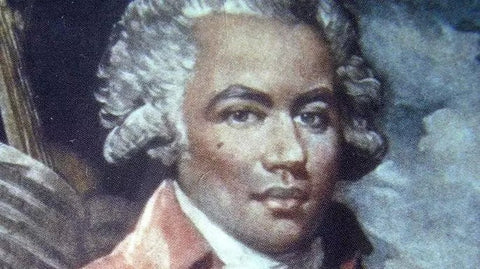
Possibly the most interesting of the 3, Joseph Boulogne, better known as Saint George, was notable for being a half-African half-French aristocrat.  Born the illegitimate son of a Frenchman and African slave, he was taken from his birthplace of Guadeloupe (an island in the Caribbean) to France at a young age.  While his maternity disallowed him from being considered nobility, his father acknowledged and supported him throughout his life, an extreme rarity due to the racial divisions of the time.

Saint George grew up with an excellent education, learning not only fencing but also horseback riding, literature, and science.  Accounted a dashing man with a fierce prowess of the sword, he gained skill quickly, with one famed Italian fencer predicting that he would become the best fencer in Europe.  Not skilled only with the sword, he also was an accomplished violinist.  While not considered one of the great composers, one of the greats, Mozart, based a piece on a melody Saint George wrote.

Saint George grew up with close ties to the Aristocracy.  His father was very close to King Louis XV, and George himself developed a close friendship with Marie Antoinette.  However, he developed sympathies for the growing revolutionary movement, though these ties made it difficult for the revolutionary leaders to trust him.  As well as his involvement with the revolution, he also sympathized with the growing anti-slavery movement, which irritated slave owners.  He lived to see slavery abolished but died soon before it was reimposed by Napoleon.

See our Practice Swords


source https://www.bladespro.co.uk/blogs/news/3-legendary-european-swordsmen

Wednesday, 29 May 2019

Genghis Khan

One of the most famous leaders of all time, Genghis Khan led the Mongols on a conquest that would eventually form the largest contiguous empire in human history.  All was not power and roses however, as he came from quite humble beginnings.

A Child Groom

There is not much known about Genghis’s early life, though legends abound due to his later prominence.  What is known is that he was born Temüjin, one of at least seven siblings.  At the tender age of nine, his father arranged a marriage for him and took him to live with his bride’s family, a political ally, until he reached the marriageable age of twelve years. 

However, this questionably happy state of affairs was not to last, for, on the way home, his father met some enemies who poisoned him.  Learning of this, the future conqueror left his bride-to-be and went home to his tribe in order to claim his father’s place as chief. The tribe rejected him, however, and he was forced with his family to flee and live of the land alone.

Temüjin had an older half-brother Begter who began to seek power as he reached adulthood, and he planned to take Temüjin’s mother (not his own mother) as his wife.  Temüjin resented Begter for this, and on a hunting excursion with his other brother Khasar, they killed Begter.

A Rising Star

Temüjin’s mother reportedly was a wise woman, who taught him about the need for political stability among the then-divided nomadic tribes of today’s Mongolia.  This teaching combined with the harsh life of the open plains began to prepare Temüjin for his future role.

Temüjin’s reputation began to increase when he was captured in a raid and later escaped.  He eventually managed to complete the marriage his father had arranged, cementing the political alliance between the two tribes.  His wife Börte was soon captured herself and given away to another man.  Temüjin managed to rescue her with the help of his closest friend Jamukha and the soldiers of an ally. This capture would have historic repercussions, as Börte gave birth to a son nine months later, making it unclear who the father was.  This would later complicate the matter of succession for the empire.

While Genghis followed the tradition of taking multiple partners, only Börte and her children received any rights of inheritance.    She bore him three more sons who would eventually become rulers in their own rights.

Two Paths Divided, One Chosen

Temüjin and Jamukha had each become Khan of their own tribes.  Childhood friends, they had taken an oath to remain faithful to each other all their lives as blood brothers.  However, their differences in governing philosophies began to cause a rift in their friendship.  Temüjin favored a meritocratic method, and as such his ranks were filled with people of all classes.  Jamukha followed the traditional path of aristocracy.  When Temüjin was eventually elected as Khan of the Mongols, Jamukha successfully attacked him, driving him into a sort of exile.

The historical records become unclear for the next decade, but eventually Temüjin was restored to power when he took part in an attack against people that had been oppressing his fellow tribesman.  Temüjin continued to gain power by marriage, this time marrying his son to a daughter of Toghrul, an ally.  However, Toghruls’s and Temüjin’s relationship was rocky at best, with Toghruls’s son Senggum unsuccessfully attacking Temüjin, and Toghrul refusing to give his daughter in marriage.  This refusal led to war, with Toghrul teaming up with Jamukha against Temüjin. However due to previous atrocities committed by Jamukha, many soldiers deserted to Temüjin.  This, combined with disagreements between Jamukha and Toghrul, led to their eventually defeat.  Jamukha escaped to the Naimans, who eventually elected him leader.  This caused another showdown with Temüjin ending in Jamukha’s defeat due to more desertions.  This defeat made Temüjin the sole ruler of the Mongols, and he took the name Genghis Khan.

The Mongol Empire

With the clans united, Genghis began planning his empire.  His first step was to invade the lands to the south.  Correctly surmising that the Xia would not be aided by the ruler of what is now northern China, Genghis attacked.  Though the conquest was successful, it was a hard one due to the Xia’s defenses.

Great Wall

With the south quelled, Genghis turned his attention to the east, to the Jin who had not defended the Xia in their time of need.  Noting the threat Genghis now posed, the Jin assembled their forces. However, due to a messenger’s defection, they lost the tactical advantage against Genghis and were defeated in a slaughter.  This forced the ruler of the Jin to abandon modern Beijing and essential surrender the northern half of his realm to the Mongols. Two decades later, the remainder fell to the Mongols.

The Mongols were tired after nearly a decade of fighting, so Genghis chose only a few soldiers to strike west.  Using nefarious tactics, they managed to weaken the Qara Khitai before attacking directly and securing the Victory.  Continuing west, they managed to secure territory all the way to the Caspian Sea.

The empire kept expanding, eventually reaching India to the south, Iran to the west, Russia to the north, and Korea to the East.

Succession and Death

Genghis managed to live to old age.  However, the closer he got to death, the more troubled the empire became over who would succeed him.  While, traditionally, his son Jochi should succeed, the question of his parentage and the refusal of one of Genghis’s sons Chagatai to support Jochi should he be named the successor made this choice untenable.  Because of this refusal, Chagatai was also disconsidered, so Genghis chose his third son Ögedei as his successor.

In order to further ease tensions, Genghis divided his empire into four Khanates and gave each to one of his sons.  Jochi’s early death meant his Khanate was given to his two sons.   When Genghis died, according to the custom of the time, he was buried in an unmarked grave.

Ögedei continued expanding the empire after his father’s death, with the Mongol Empire eventually covering all modern-day China, as well as reaching Eastern Europe.

The Sword Behind the Man.

While it is uncertain exactly what weapon Genghis would have used on the battlefield, the Mongols used a type of slashing sword heavily related to the Chinese Dao.  As their empire expanded, they adopted Persian weapons such as the Scimitar.

See our Dao Swords


source https://www.bladespro.co.uk/blogs/news/genghis-khan

Wednesday, 15 May 2019

The Middle Eastern Calvary Sword: The Scimitar

An Eastern Cavalryman

Zordun charged across the open plains on his horse.  The wind blew in his face as he leaned down, urging a bit more speed from his mount.  As he did so, he heard the soft whisper of hundreds of arrows whistling through the air above him.  Barely managing to keep his eyes open against the dust stirred up from the sun-baked plains and the light of the noonday sun, he saw the arrows landing in the infantry in front of him, causing men to stumble and fall in cries of pain. 

He saw an answering rain of arrows rise up from behind the men and whistle past him, landing in some of the men unfortunate enough to ride slower than him.  Sending up a silent prayer of thanks for his swift ride, he slowed his horse slightly and raised his Scimitar, primed for battle.

Featured Sword: Scimitar

Scimitars and Katanas may seem similar at first glance - they are curved, Eastern swords developed near a thousand years ago. However, that is where their similarities end.

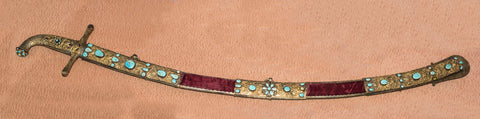
The first main difference lies in the forging process.  Scimitars are typically not forge welded like Katanas (heated, then welded to itself), they are beaten into shape blow by blow.  Thus they are made already curved - the shape provided by the smith at creation.  However, Katanas are made straight and remain so until they are quenched, at which time the uneven cooling of the blade due to clay applied by the swordsmith causes the blade to curve.

The second difference comes in their usage.  The scimitar was developed primarily for use on horseback.  The deep curve of the blade is excellent for slashing and making sure that the blade does not stick into its target - an excellent feature when riding by a target quickly.  Katanas were made to be status symbols and to finish duels between two lightly armored opponents quickly - often in one or two strokes.  A result of these different design choices are that Scimitars are worn with the edge down, while Katanas are worn with the edge facing up.

Finally, scimitars are one-handed weapons whilst Katanas are two-handed.  This means that the handle on a scimitar is much shorter than the Tsuka of a Katana.  The main exceptions are scimitar swords made for executions (needing two hands) and certain Katana fighting styles (such as duel-wielding).

Laying Waste

Swerving left and right to avoid the blows of the men around him, Zordun skillfully guided his horse.  Balancing carefully to remain upright, he skillfully slashed his blade at the nearest infantryman, causing a screen of pain and an arm to go limp.  Steeling himself for the next blow, he struck at an armored opponent, the blade going deep and hitting bone, then glancing off.  Knowing a straight sword would have likely stuck in the bone and risked pulling him off his horse into the thick of the battle, he again said a quick prayer of thanks.

Fun Facts

British officers began wearing mameluke swords after the Battle of Waterloo, especially by commanders of light cavalry and hussar units.  Today, the current regulation sword for generals is a Maeluke sword.

Etymology

The word Scimitar comes from either Middle French cimeterre or Italian scimitarra, both of which probably originally came from an Ottoman Turkish word that itself descended from the Persian word shamshēr (شمشیر‎ ) which literally means "paw claw".

Variations

There are many variations of Scimitars, each with their own name.

  • Shamshir (Iran)
  • Kilij (Turkey and Egypt)
  • Nimcha (Morocco)
    Pulwar (Afghanistan)
  • Talwar (Indian Subcontinent)
  • Kirpaan (Punjab, North Western India)
  • Shotel (Horn of Africa, primarily Ethiopia and Eritrea)
List credit of Wikipedia

See our Swords >

source https://www.bladespro.co.uk/blogs/news/scimitar

Wednesday, 1 May 2019

Hua Mulan - The Most Famous Chinese Woman Warrior

The original story of Mulan is short, only a few hundred characters. But the story contained inside is unique and powerful, especially for the time period in which it was written. Set in the first half of the first millennium, it chronicles the story of a girl who takes her father’s place and joins the army.

Flower

While it recently gained fame as a Disney movie worldwide, the story has been popular in China for millennia. Unlike the movie, there are no romantic subplots in the original poem but only the familial love of a daughter for her father. Short and sweet, its meaning is timeless.

The Story

The poem starts with Mulan working at her loom. She is asked whom she longs for, and she answers that she has no one she desires, but instead worries for her father, whose name is on every draft notice in town. She notes that her family has no older male to serve, and she wishes she could take her father’s place.

The next section of the poem describes her buying a horse and tack from around town. She leaves her family’s home at dawn and travels to the army camp, arriving at evening. This section has a repeated line that is difficult to translate, but seems to refer to how Mulan is so focused on her mission that she doesn’t consider how her family misses her.

The following part details her long and varied service. She serves for ten years, traveling over ten thousand kilometers through the north of China and probably parts of what are now Mongolia and Russia.  She fights in over a hundred battles, and many of the army's leaders are killed over the course of the campaign.  While never directly said, it is heavily implied based on what happens next that she is repeatedly promoted.

When the long and bloody campaign is finally over, the army travels to the capital where she meets the emperor as part of a celebration. He hands out rewards to all and official posts to distinguished commanders.  When asked what she wants, she refuses a post, but asks simply to be allowed leave to return home and a fast horse to take her there.

Her family receives word of her immanent arrival.  Her parents go out to see her, her sister dresses up, and her younger brother goes to slaughter some of the livestock for a feast in her honor.  Mulan arrives and makes her way to her room where she trades her armor and battle clothes for a lady's dress and cosmetics.  It is implied that her hair is white, signaling just how stressful the campaign had been and how it had aged her.

Her companions who had traveled with her are amazed and astonished when they see her, for in all the years of traveling together they had never suspected who she was.  The poem ends with an analogy from Mulan relating how when rabbits run together, it is impossible to tell their sex.

History

The poem is nearly as old as the story it contains - written only one or two centuries after the events it purports.  However, we have no early copies, and the first reference we have of the poem is from a 12th century work in which the author references an earlier source.

In the poem, Mulan has no surname.  Later adaptions gave her different surnames, with "Hua", meaning "flower", becoming the most popular.  This is likely because in Chinese, "Mulan" means magnolia, so the name is more poetic.

Disney wasn't the first to play loosely with the story.  In the 1670s, Chu created an intriguing adaption in which Mulan, after leaving to join the army in her father's stead, becomes best friends with a king's warrior daughter.  When the king is captured and sentenced to death, they try to have themselves executed instead.  However, their act of loyalty is rewarded, and Mulan is granted riches and a place for her family to relocated.  Returning home, she discovers her father has died and her mother has remarried.  She also receives word that the Emperor has taken an interest in her and she is to become his concubine.    Rather than acquiesce, she decides to commit suicide so she can be with her dead father.

Chinese Weapons

There were five main Chinese weapons: dao, jian, spear, halberd, and staff.  While we don't know which weapon Mulan trained with or used, it is likely that she would have used a Dao, as they were easy to learn, plentiful, and reliable. 

 Chinese Dao Sword

See our Dao Swords


source https://www.bladespro.co.uk/blogs/news/hua-mulan