Wednesday, 20 February 2019

The Witcher

The Witcher franchise follows the adventures of Geralt of Rivia, a genetically-altered monster-hunter.  Possessing greater strength, stamina, and speed than a normal human, he also has limited use of magic through the use of Witcher Signs -  simple spells that require only a gesture and concentration to cast.

Witcher Villa

The Adventure Begins - Books

The world of the Witcher was first revealed by author Andrzej Sapkowski through a short story about Geralt written for a contest held by the Polish science fiction magazine Fantastyka.  It was followed by three more short stories, one of which was a prequel that featured Geralt’s mother.

The book series focuses primarily on Geralt, his daughter Ciri, and his lover Yennefer.  Geralt is also often accompanied by Dandelion, his best friend and a minstrel. The series features common fantasy races such as elves, dwarves, gnomes, and, of course, humans.  Other common magical creatures make appearances including vampires, werewolves, halflings, and dryads.

The name of the series “Witcher”, was purportedly inspired by the male versions of the world “witch” in English and German.  Thus, Sapkowski coined a new Polish word “wiedźmin” to be the male equivalent of the already-existing word wiedźma.

Expanding the Story - TableTop RolePlaying

Soon after the main series line was completed, the first tabletop roleplaying game was developed. Released in 2001, it was called called Wiedźmin: Gra Wyobraźni (English: The Witcher: A Game of Imagination) and was based off the books    A second game was released last year (2018), but this one was based off the by-then successful video game franchise.
Witcher Cave

Going National - TV and Movies

Following a similar release schedule to the roleplaying games, in 2001 the first Witcher movie was released, followed in 2002 by a TV series by the same name.  Both were hated by the series author. Over a decade later, an American movie was planned for 2017, but has since morphed into a TV series that is still in development (as of early 2019).

International Success - Video Games

By far the most successful spin-off of the books, three successful video games have been developed that loosely following plot lines from the books.  A notable feature of all three games has been their delayed consequences mechanic - decisions made early on in a game has profound impact later. This mechanic enhances replayability and prohibits save-and-reloading by players looking for the best short-term outcome.  The series is also noted for its morally grey choices - where there is often neither a clear good nor bad option, but rather a mix of both.

The first Witcher video game was released on PC in 2007. It featured a unique combat system that made it markedly different from other roleplaying games.  The licensing rights were acquired for a mere $9,500 paid up-front even though the author was offered royalties, a decision he would later come to regret.

The second Witcher game was planned to be the first but re-released on console with a new combat system in 2009, but this failed, so work was transferred to another game which eventually became The Witcher 2: Assassins of Kings, released in 2011 on both PC and console. It featured a more complex combat system, more complex ability upgrade system, and a new stealth system. This second game was noted for its varied storypaths, with the game developers stating there were “16 different states of the world” that could be explored. Selling over 1.5 million copies, the game was a greater success compared to the original.

The final video game installment that follows Geralt as the main protagonist was released in 2015 to rave reviews and vast commercial success.  Selling over 10 million copies and earning profit of over $63.3 million dollars, the game has been considered one of the greatest video games of all time.  It was noted for its large open world, memorable side quests, and multiple new systems that gave the game a more realistic feel.

The Swords of the Witcher

Witcher Swords

There are two main types of swords in the Witcher Series: steel and silver.  Steel swords are used against most common foes, especially humans. Strong and sharp, they don’t don’t break easily and can do a surprising amount of damage.  Silver swords, by contrast, are used only against magical foes. Silver is much softer than steel, so it wouldn’t last nearly as long against enemies that weren’t supernaturally vulnerable to it.  Silver swords are not pure silver however, as they contain a steel core which gives the blade strength.

See our Witcher Swords >


source https://www.bladespro.co.uk/blogs/news/witcher-franchise

Wednesday, 6 February 2019

The Katana’s Predecessor: The Tachi

In the Calvary

Riding with his cavalry contingent, Reo was a bit nervous. While he had been training as a Samurai for years, he had only recently been allotted a horse.  In the few months since then, he had been practicing as often as he could, but it was so different from fighting on foot. If there were actual combat, he wasn’t sure how well he would perform.

A few hours later, the sun was just starting down from its noonday crest.  The hills, barren of shadows for the moment, would soon begin sporting new ones, perfect hiding places for an ambush.  He heard some voices up ahead and saw three men running down a hill just ahead, their feet kicking up dirt into the dry air.  They were scouts, and from their rush seemed to have some important news...

***

Once the scouts reached us, they told us the news. They had spotted some men up ahead, and, while they were few in number, it was possible they belonged to a larger force nearby.  The scouts assured us that they had not been seen. My commander decided that the few of us on horse had the best chance of catching them, so he dispatched us with one of the scouts to the men’s location, to use the horse's speed to close the gap once we were spotted.

10 minutes later, the scout motioned for quiet and we pulled our horses to a stop. He steadily climbed up the hill, and peeked over it, careful to keep his head down low.  Coming back down, he informed us the men we were looking for were in the valley behind the hill.  Our leader decided we would ride around the base of the hill and catch them on the other side, while our scout would again summit the hill to make sure no one got away.  In anticipation of the coming order to attack, Reo quietly drew his Tachi...

Featured Sword: Tachi

Tachi swords were originally developed around 900 AD and commonly made until about 1600.  Typically 2-3 Shaku in length, they are slightly longer than a Katana, the sword to which they are most often compared.  However, there are other differences between the two. Both the Katana and Tachi are curved, but the curvature of the Tachi is greater.  Additionally, Tachi are worn with the cutting edge down, while Katana are worn with the cutting edge up. Because a swordsmith’s signature would be put on the side of the tang facing outward when worn on the wielder’s left side, this difference in wearing style meant that the swordsmith’s signature on a Tachi and Katana are on opposite sides of the tang.

Because of its greater length than the Katana, the Tachi has been suggested to have been used as more of an open-field weapon.  In combat, the person whose weapon has the greater reach almost always has the advantage, so the Tachi with its longer length would have been preferred  However, it would be less effective in more closed-in spaces. A further suggested use of the Tachi would have been its use on horseback, as longer reach is even more important for calvary, and the cutting edge worn down would seem to fit the needs of a horseman more.  However, we lack early contemporary references to horseback combat, so we don’t know for sure.

A Careful Ambush

My troop carefully trotted around the base of the hill, guiding our horses and keeping them on the firmer, greener grass where the water flowed through between the hills in order to muffle the sound of the horses’ hooves.  Three-quarters of the way around the base of the hill, we heard a shout. We had been spotted! Quickly heeling our horses forward, we pushed our horses to a gallop, quickly spotting the men and adjusting our path to intersect.

50 meters, 40, 30, 20, 10...and we were on them.  Carefully raising my Tachi as I had trained, I aimed at the men, making careful and deliberate swings while I rode past.  I had to be very careful not to hit the horse while keeping my balance - a very difficult feat on a moving horse while swinging at a moving target. One of my swings connected, and one man went down.  I heard a horse bellow behind me. Looking back, I saw one of my comrades' horses had a large gash accross its flank. The man who had made it was quickly cut down by another one of our number, but the horse did not look good.  Wheeling back, I saw all our targets were down. Now we had to decide what to do with the horse...

Fun Fact

Originally worn with a Tanto as the larger weapon in a Daishō (大小, big-little pair), they were eventually replaced several centuries after with the Katana and Wakizashi pair.

Etymology

From the Old Japanese word “Tati” meaning “sever”, the pronunciation changed to “Tatsi”, then eventually to the modern “Tatchi”.  In Kanji, it is written as 大刀, meaning “great/big Katana”.

See Our Tachi Swords >


source https://www.bladespro.co.uk/blogs/news/tachi

Wednesday, 23 January 2019

Chinese Swordsmithing - A Rediscovered Treasure

Japanese swordsmithing is renowned worldwide, and for good reason: the blade quality is superb, and the fittings are works of art in their own right.  Using traditional methods, a sword made by a mastersmith can take months to prepare and can run in the thousands to millions of dollars to purchase - when one can be acquired at all.  In contrast, Chinese swordsmithing is still relatively unknown, perhaps because it was used more for arming infantryman rather than serving as a status symbol for noble Samurai. However, if we look back at the history of Chinese sword production, we uncover a few surprises.

Ancient Chinese Swordsmithing

Chinese swordsmithing began development early, with knives found dating as far back as 1200 BC.  As time progressed, those knives lengthened until they could be considered short swords, and they eventually began to replace daggers and axes in the 7th century BC.  Up until this point they were made of Bronze, but, around the 6th century BC, steel processes were imported from India, and China began steel production. While poor at first, the quality of steel blades quickly improved, and with the discovery of quench-hardening in the 3rd century, bronze weapons went obsolete.

Chinese swords are divided into two types: the Jian and Dao.  The earliest swords were Jian, double-sided weapons, as they descended from daggers.  Dao swords were created later, as it was discovered that dulling one of the sides and thickening it could strengthen the blade, making it more reliable and less prone to breaking.  In addition, Jian blades are straight, while Dao blades, especially later ones, tend to be curved. Some people believe that the curved Dao influenced the Japanese toward making their own curved blades such as the later renowned Katana and Wakizashi.

By the 2nd century BC, the Jian and the Dow were each considered one of the Five Weapons - along with the spear, halberd, and staff.  As swords became useful when paired with shields or used for cavalry, the Dao became the weapon of choice for battle. Jian weapons were still used, but, because of their lower durability, were wielded only by experts or officials.  Around this time, it is possible that Chinese swordsmiths discovered that coating swords with chromium oxide would protect them from rusting, a technique soon lost that wasn’t re-discovered until the 1930s and 40s by the Germans and Americans.

Time continued until the 6th century AD, when co-fusion steelmaking was developed (combining different iron ores with varying carbon content).  This greatly enhanced swords by giving them the best of both worlds - a hard but brittle edge with a soft but flexible spine. It also seems to have given them an advantage against contemporary armor.  Around this time, Chinese sword-making techniques were imported into Japan by immigrants from China, and the Japanese began their own sword traditions.

However, Chinese sword development did not stop as Japan’s began, but they both continued down separate paths in parallel.  For another 6 centuries in China, the Dao continued its dominance over the Jian, and was divided into 4 categories: Ceremonial, Cross, Defense, and Divided.  Ceremonial Daos were ornate and decorated with precious metals. Cross Daos were worn by crossbowmen as a sidearm. Defensive Daos were used for, you guessed it, self-defense, and Divided Daos were longswords attached to meter-plus long handles - some of these weapons reaching up to 3 meters in total length!  Around the 12th century AD, the Jian experienced a short period of revival, until again being overtaken by the Dao a century later.

After this period, less is known about Chinese swords as there is little written material to work with.  A few reasons have been suggested for this. One such reason is that sword-making in China was so well-established and developed that there was little need to continue writing books on the subject, so instead attention was given to newer technologies.  Another idea is that because of Confucian values urging against militaristic pursuits in favor of cultural ones, the sword was no longer a “worthwhile” subject to write on. Whatever the case, while there may not be a large written tradition from those times, swordmaking in China never truly stopped, and today there are swordsmiths in China whose swords’ values match and even outstrip their Japanese counterparts.

Modern Chinese Swordsmithing

Chinese swordsmiths gain experience through the time-honored tradition of apprenticeship, often starting in their teenage years and continuing for years before they can hope to obtain the rank of master.  Of those who do eventually reach master-rank, China divides into 3 levels: city-level master, province-level master, and country-level master (also known as a national treasure smith). Levels 1 mastersmiths typically work for large factories or small smithies owned by others.  Levels 2 and 3 mastersmiths usually work at their own forges, with a few owning their own factories. Level 1 mastersmiths can command prices of around $5-10K for a sword. Level 2 smiths can command prices from $10K and up, and swords made by Level 3 masters range from over $100K to over $1M. Some mastersmiths choose to specialise, creating only the blade, while others choose to generalise, creating the fittings as well.  The work of Level 2 and 3 swordsmiths are considered meritorious enough that some of them have been chosen to gift swords on behalf of the Chinese nation to foreign heads of state.

Today, Chinese swordsmiths have learned how to make Japanese swords along with their own, using the traditions shared by both and a few imported techniques such as folding. (Folding was not developed in China because they had access to better iron ores than Japan, making folding unnecessary.  Today it is used mainly for the aesthetic appeal of such folded swords.) Because of this, Japan and China are two of the few countries using traditional techniques passed down over more than a millennia to craft swords similar to those made by their ancestors. If you’d like to see representations of ancient Chinese swords, please see our Chinese Sword collection*.

See our Chinese Swords >

*Note, these swords are for ornamental or display use only.


source https://www.bladespro.co.uk/blogs/news/chinese-swordsmithing

Wednesday, 9 January 2019

The Best Of 2018: Blood Grooves, Female Samurai, Ninjas VS Samurai, Steel Types & More

We think the best customers are well-informed customers, so we do our best to find valuable information and present it in a way everyone can enjoy.  As swords enthusiasts ourselves, we feel such information should be shared freely among all who share our passion.

Thus, in 2018, we worked hard to update old articles and create new ones chock full of information for old and new sword enthusiasts alike, while also making them fun and engaging to read.  Now, at the beginning of 2019, we look back at the results of our undertaking and feature the articles we and you liked the most.

Staff Picks

We asked our team to choose the posts they liked the most, and give their reason why.  Here are their top picks:

Female Samurai - The Onna Bugeisha - "My favourite post for 2018 was the one about the Onna Bugeisha. I am the only female in our team, and learning about Samurai and their history is a great passion of mine, so I was thrilled to learn about the role of women and the courage of some female samurai.

For over half a millennia, women stepped up to the plate to defend their homes and families as the men left for battles. Within their communities, these women became great examples of courage, leadership, and strength. This article shines a light on the less famous, yet equally fierce female samurai." - Silvia.


The Magic of the “Blood Groove” - "I love how the blood groove (aka "Bo-Hi") is woven into the story of Kana, showcasing its usefulness in lightening the blade while also making it a fun, engaging and personal read." - Tristan


The Ninja vs The Samurai - "I like how the story is engaging while trying to stay as historically accurate as possible, even while creating the unlikely engagement between a samurai and a Ninja.  The information is interesting too." - Ryan 


Top 3 Read

The next three posts were the ones you liked the most, judged by total page views.

Guide to Types of Sword Steel – Everything You Didn’t Know You Needed to Know - No story here, but chock full of information, from the attributes of each type of steels used in swords to whom they are best for.

Norimitsu Odachi: Who on Earth Could Have Wielded Such a Sword? - There is a gigantic sword in Japan measuring over three meters!  Who made it and why? We explore several possibilities.

European Longsword vs Katana? - This question has plagued sword enthusiasts for centuries.  Here we attempt to answer the question while being as fair as possible to both swords.


Popular Reference Posts

We also noticed that a lot our readers (that's you!) looked for the following information, so we thought we'd put it front-and-center.  They have been updated to be current for 2019.

Are samurai swords, katana and wakizashi legal in the UK? - In short, yes, if made a certain way.  See this post for full details.  (All our swords are UK legal).

Sword Maintenance and Care - Chock full of advice for keeping your new sword looking shiny for years (or even decades).


source https://www.bladespro.co.uk/blogs/news/best-of-2018

Tuesday, 25 December 2018

Boxing Day Sale: Discounts on our 2018 Best Sellers and Free Engraving on ALL Swords


We're having a one-day sale with big discounts on our best-selling swords on Boxing Day, December 26th!  ALL swords -- both discounted and not  -- also come with FREE engraving (normally £15).

Click here to start shopping 2018 Best Sellers

Sale Info*

  • MASSIVE SAVINGS on our 2018 best-sellers
  • FREE Engraving on all swords
  • Sale one day only - from midnight to midnight on the 26th.

Shop 2018 Best Sellers >

*Click here for full terms and conditions of the sale. 


source https://www.bladespro.co.uk/blogs/news/boxing-day-sale-discounts-on-our-2018-best-sellers-and-free-engraving-on-all-swords

Monday, 24 December 2018

Best Selling Swords of 2018

As 2018 draws to a close, we're taking the time to look back and reflect on the previous year. Striving to serve you best, we are constantly updating our product selections, taking your feedback into account. Here are the top Best-Selling Swords of 2018, picked by you, our beloved customers.

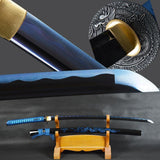
#1 - Blue Blade Samurai Katana

Blue Blade Samurai Katana

The beautify of this Sapphire Sword makes it clear why it's our customers' #1 pick. The ornate details on the Tusba and Saya are stunning, and the deep color draws in one's eyes. While not cheap, it remains affordable at just under £200.

Like this sword? You can buy it here.

#2 - Kikyou Katana Samurai Sword ESA815

Stunningly white with a simple radial Tsuba, this battle-ready sword is popular with martial arts enthusiasts. An excellent mid-tier sword.

Like this sword? You can buy it here.

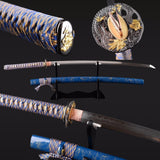
#3 - Dara Clay Tempered Folded Steel Katana Samurai Swords

Dara Clay Tempered Folded Steel Katana Samurai Sword

Both colorful and complex, the attention to detail of this sword shows through. The layers of the folded steel perfectly compliment the coloured streaks of the fittings. The quality demands a higher price, but, as its place of #3 on the list shows, many of our customers think it's worth it.

Like this sword? You can buy it here.

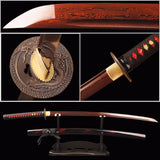
#4 - Ruolan Folded Red Steel Katana Samurai Sword

Ruolan Folded Red Steel Katana Samurai Sword

Bearing gorgeously deep red steel combined with simple but well-contrasted fittings, it is no wonder this sword has proved popular enough to reach the #4 spot. Similar to our #1 sword, this comes in at just under £200.

Like this sword? You can buy it here.

#5 - Atid Clay Tempered Steel Katana Samurai Sword

Atid Clay Tempered Folded Steel Katana Samurai Sword

Mostly black, this sword projects a dash of colour on the Saya. Made of folded steel, this high-quality sword's beauty comes from its functional elegance.

Like this sword? You can buy it here.

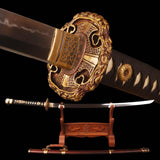
#6 - Yamamoto Clay Tempered Katana Samurai Sword

Yamamoto Clay Tempered Katana Samurai Sword

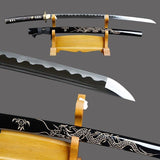
5cm longer than most, this sword is further distinguished by the random-looking Hamon line - a mark shared by the highest quality swords. Adorned with golden fittings, this sword is truly regal. Definitely a notch (or two) above most swords, it's not for the budget collector.

Like this sword? You can buy it here.

#7 - Dotanuki Clay Tempered Katana Sword

Dotanuki Clay Tempered Katana Samurai Sword

Red is the name of the game here. Boasting many different shades, this fiery sword's fittings wonderfully contrast its black blade. Both Folded and Clay Tempered, its high-quality blade makes its price above average.

Like this sword? You can buy it here.

#8 - Qingge Folded Blue Steel Katana Samurai Sword

Qingge Folded Blue Steel Katana Samurai Sword

Bright blue with touches of red, this lively sword is sure to draw attention. Further distinguished by its artistic Tsuba, this aesthetically pleasing sword is quite affordable.

Like this sword? You can buy it here.

#9 - Kurosaki Ichigo Bleach Sword

Kurosaki Ichigo Bleach Sword

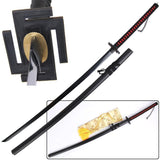
Our Bleach collection has been rapidly rising in popularity, with Ichigo Kurosaki's Zanpakutō Zangetsu reaching the top 10 in a remarkably short time. Revisit the world of Bleach with the sword of the protagonist.

Like this sword? You can buy it here.

#10 - Taniko Katana Samurai Sword

Taniko Katana Samurai Sword ESA804

Another sword popular with martial artists, this well-styled functional blade is ready for action. Affordable, it comes in at just under £200.

Like this sword? You can buy it here.


source https://www.bladespro.co.uk/blogs/news/best-selling-swords-2018

Wednesday, 12 December 2018

Female Samurai - The Onna Bugeisha

Two Leaders

Tomoe Gozen, first captain and wife of Minamoto no Yoshinaka, surveyed the field where the final battle was sure to soon take place.  A warrior first and foremost, she was dressed in full armor and carrying an oversized sword as well as a bow. Her husband Yoshinaka had recently taken Kyoto, the capital, and set himself up as head of the Minamoto clan.  Unfortunately, his cousin Yoritomo couldn’t leave well enough alone and had sent his two brothers with armies after Yoshinaka. Driven out of Kyoto, Tomoe and Yoshinaka had retreated here to Awazu, where would soon begin the battle to decide the leadership of the Minamoto clan, and, because of its status of Japan’s most powerful clan, the entire country.  As first captain, it was her job to lead the soldiers into the part of the battle where the fighting was thickest and ensure the victory.

Hōjō Masako, wife of Minamoto no Yoritomo, sat with her husband in the command tent, helping to manage the affairs of her husband’s armies.  They had been waiting for several days to hear back from Yoritomo’s cousins, who had been sent to chase down Yoshinaka after he decided to split from the rest of the clan and set himself up as effective emperor, taking Kyoto and kidnapping the emperor while burning down the palace in the process.  No stranger to the world of men, Masako had been taught from a young age horseback riding, hunting, and fishing, for she had been been raised among men rather than with her mother and sisters. While she an expert warrier, she was an even better general, and her husband valued her leadership abilities and took her with him on all his military campaigns, where she led to great effect.

The Onna Bugeisha

Both Tomoe Gozen and Hōjō Masako are famous examples of Onna Bugeisha, more commonly known as female Samurai.   Japan’s past is filled with internal and domestic strife, with attacks between villages quite common. Because of this, in ancient Japan, women were trained to defend their villages alongside the men, or without them if the villages lacked male fighters.  After the formation of the Samurai, some of these women became warriors in their own right.

One of the earliest Onna Bugeisha, Empress Jingū is a figure shrouded in legend and is thought not to have existed as a historical figure, however, her story is important as it embodies the very spirit of what it means to be a female samurai.   According to some chronicles, she led Japan after the death of her late husband, the fourteenth emperor until her son was old enough to take the throne. During this time, she not only improved Japan by making influential economic and social changes, but personally led a victorious invasion of Korea over the course of a three-year campaign.

The legacy of the Onna Bugeisha stretches over one and half millenia, from legends to modern history.  While Empress Ji is possibly the earliest, later examples of heroic women include Tomoe Gozen, Hojo Masako, and Nakano Takeko, who lived as late as 1868 and is credited with 172 samurai kills.  Of course, there are innumerable others who are not as well known, or have been lost to the ravages of history.

The Onna Bugeisha used naginata as their primary weapon, specifically the ko-naginata, a special version designed for women.  A naginata is basically a sword on a pole with a curved blade at the top. Because women are usually of smaller stature and have less upper body strength than men, their blades were smaller in order to reduce the weight. The main advantage of the naginata is that, because of its length and thus range, it partially negates the greater reach and strength advantage that men naturally have, allowing for more fair fights.  It was also very useful for dismounting riders in cavalry charges. The naginata eventually became as iconic to the social status of women as the Katana was the to the Samurai.

Aftermath

The battle was fierce.  Gozen mired in the thick of it, She fought soldier after soldier and pressed ever on, encouraging those around her through her example.  She climbed a ridge, and at the top, saw a line of Samurai at the bottom of the valley. Looking up, their eyes widened with recognition when they saw her, then they yelled and charged up the hill.  Calling her retinue to her, Gozen prepared to meet them. The first to fall to her Katana was Uchida Leyoshi. In his haste to capture her, he made a critical misstep that allowed her to step to the side and kill him.  His companion Hatakeyama Shigetada was a much better fighter. Dodging blow after blow, they fought valiantly, though both were tired already from the battle. When a slight respite allowed, Tomoe took stock of the situation and realized that her forces were being outrun. Knowing she was more valuable alive, she took the first opportunity she saw to disengage, and managed to leap on her horse and escape.  Determined to find her husband, she rode like the wind....

Masako noticed a disturbance in the outer camp.  Within a few minutes, a messenger was brought to them.  Her husband asked the messenger for news, and she listened attentively, wondering what changes in the campaign would soon need to be made.  The message was short but important: Yoshinaka and his forces had fallen. His wife Tomoe Gozen had been spotted leading near the front lines, and some of their best Samurai including Uchida Leyoshi and Hatakeyama Shigetada had attempted to capture her.  Unfortunately, she had managed to elude capture, killing Leyoshi in the process.  While no one knew where she went, her body had not been found among the dead. After the messenger left, Masako turned to her husband who was looking at her expectantly. With Yoshinaka out of the way and her husband now the strongest military leader in Japan, she knew her diplomatic talents would be crucial in the coming years. This was only the beginning.  

Want to see our Samurai sword range? Click here.


source https://www.bladespro.co.uk/blogs/news/female-samurai-the-onna-bugeisha